.png)
Virtual Instructor-Led Training (VILT) has become one of the most widely used learning formats in modern organisations.
This article is not about whether VILT works. It is about why it often doesn’t and how leaders should redesign their approach in 2026. This article breaks down Virtual Instructor-Led Training from a leadership and system-design perspective, not a technology or facilitation checklist.
What is Virtual Instructor-Led Training?
A live, synchronous learning event where an instructor and learners interact in real-time within a digital environment. Also referred to as virtual classroom training, live online training, or synchronous online training, VILT brings real-time facilitation and interaction to distributed learners anywhere in the world.
It isn't a pre-recorded video (that’s on-demand learning). It isn't a one-way broadcast where 500 people listen to a CEO speak (that’s a webinar). VILT is a small-to-medium group setting where the instructor can see the learners, the learners can talk to each other, and real work gets done in real-time.
Where VILT fits in the modern learning stack
VILT is not a replacement for all learning formats- it is a strategic bridge between self-paced digital learning and in-person workshops.
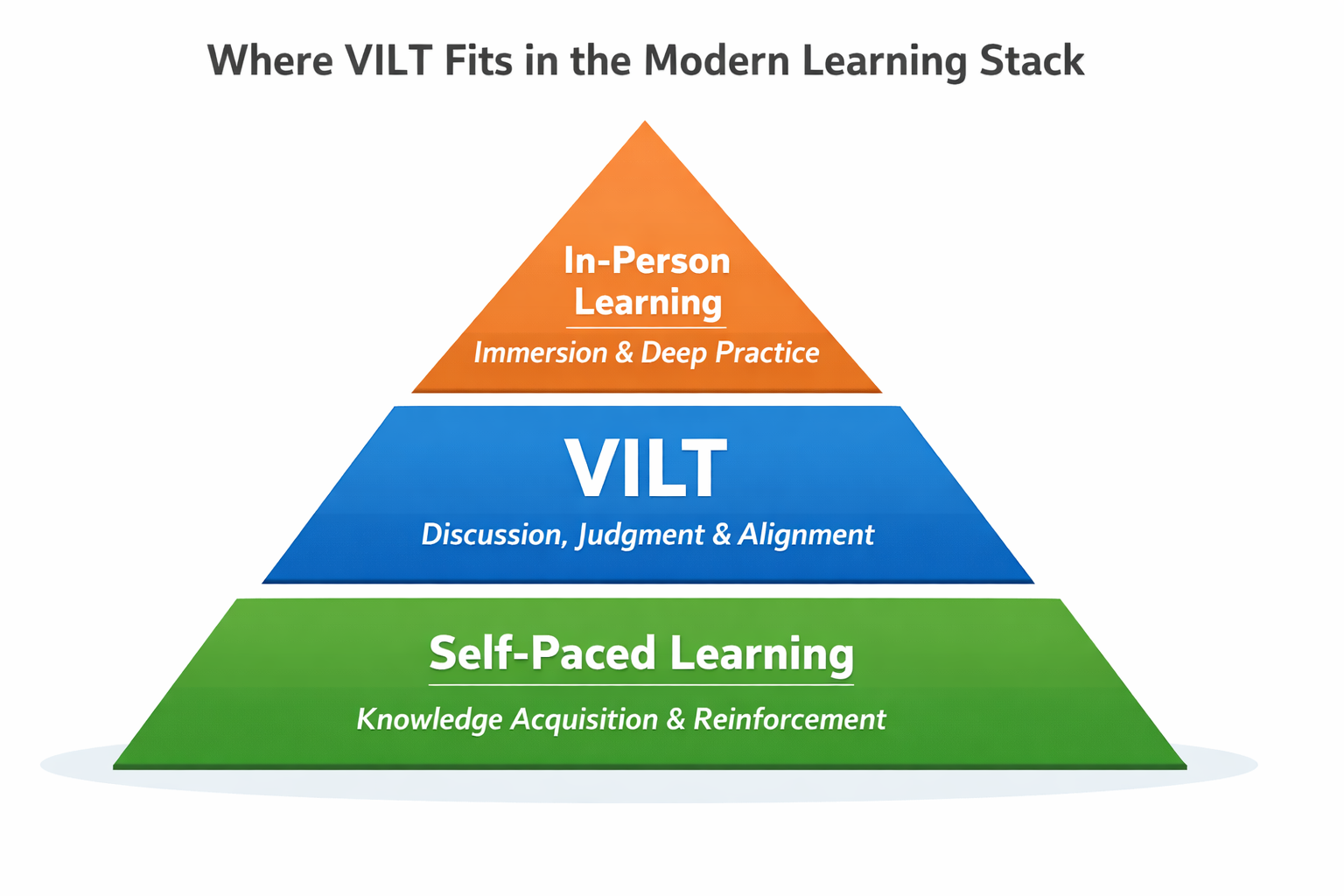
It combines the scale and speed of technology with the judgment and interaction of live facilitation.
VILT is most effective when organisations need to:
- Roll out learning rapidly
- Maintain interaction and discussion quality
- Reach distributed teams across geographies and time zones
- Be consistent with learning, ensuring the same message, structure, and decision practice reaches every cohort, reducing variability common in repeated classroom delivery.
Why VILT has become so relevant for businesses
VILT addresses the following realities by allowing organisations to deliver live learning experiences at scale without the friction of physical logistics.
- Breaks the cost curve: VILT decouples training cost from headcount. Once designed, programs can scale without proportional increases in delivery expense, shifting spend from logistics to capability building.
- Live interactivity: Learners and instructors engage through live video, chat, Q&A, and breakout rooms. Polls, whiteboards, shared workspaces, and group exercises enhance participation.
- Creates consistent capability at scale: Standardised design ensures every cohort receives the same core experience, reducing outcome variability caused by trainer, location, or batch differences.
- Parallel participation: Unlike a physical room where only one person speaks at once, VILT allows 50 people to brainstorm simultaneously via chat and digital boards.
- Accelerates speed-to-competency: Learning can be deployed simultaneously across regions and roles, allowing organisations to enable new skills in weeks rather than quarters critical during transformation.
- Increases organisational learning velocity: Training moves from one-off events to repeatable learning cycles that can be launched, reinforced, measured, and refined as business needs evolve.
VILT clearly solves many of the structural challenges facing modern organisations: cost, scale, speed, and consistency. The gap is not in the potential of VILT, but in how it is designed and used. When it is implemented as a direct translation of classroom methods without rethinking interaction, reinforcement, and facilitation, it loses the very advantages that make it powerful.
The most common reasons VILT underperforms
When VILT fails, organisations often blame:
- facilitators - “they’re not engaging enough”
- learners - “attention spans are low”
- technology - “Zoom fatigue”
But the failure is rarely technological. Video platforms are reliable. Internet connectivity is improving. The real problem lies in design assumptions.
1. Classroom content forced into virtual time.
The biggest reason virtual training fails is that it's treated like a physical lecture.
Most VILT agendas are designed in the form of slide decks, long explanations, minimal learner action, “we’ll do activities if time permits. In a physical room, a trainer can use their energy and "presence" to keep people awake, even if the slides are boring. On a screen, that doesn't work. A slide deck with too much text becomes a sleep aid. This results in attention drops, participation narrows, and retention suffers.
2. No interaction architecture
Sessions are designed as linear presentations with a few engagement elements added as afterthoughts, like ‘an end-of-session Q&A’, an occasional poll, or an open chat window. There is no deliberate structure defining when, how, or why learners should interact during the session. Without an interaction architecture, participation becomes uneven and predictable. A small number of vocal participants dominate the discussion, while the majority remain passive observers.
3. No reinforcement loop beyond the session
Reinforcement is the set of activities that happen after a session, designed to support learners as they attempt to apply new knowledge and skills on the job. Without reinforcement, newly learned behaviours quickly erode as employees fall back on familiar ways of working, the return on training investment diminishes rapidly, and initial understanding never matures into consistent, on-the-job capability.
4. The "Camera-Off" culture & multitasking
In many virtual sessions, training is just "background noise" while the employee does their "real" work. In a physical room, you wouldn't pull out your laptop and start typing while a trainer is looking at you. In a virtual room, that social pressure disappears. Without a "Cameras-On" rule or constant interaction, many people are actually answering emails or Slack messages while the trainer is talking. If you have 50 people in a session and the chat is moving a mile a minute, learners will try to read the chat while listening to the speaker. The human brain can't actually do both.
5. The "Dual-Hatted" trainer (Lack of a pilot)
In many companies, the trainer is expected to be the expert, the teacher, and the tech support all at once. Trying to teach a difficult topic while also watching the chat window and managing tech is too much for one person. The trainer misses social cues and the "vibe" of the group. When a trainer has to stop talking to fix someone’s "mute" button or struggle with a breakout room glitch, the flow of the lesson is killed.
Solving these issues requires a shift in how VILT is designed. In enterprise-grade programs, sessions are not built to deliver content but to drive participation, practice real decisions, and produce observable learning outcomes.
What enterprise-grade VILT actually looks like
High-quality VILT treats the session as a live performance space designed for interaction, judgment, and accountability rather than a slide-led presentation.
1. VILT is designed as a performance environment, not a presentation
In strong VILT programs, the session is not treated as a time slot to ‘cover content’. It is treated as a live environment where people practice making decisions they will face at work. Slides still exist, but their role changes. They support thinking, not replace it. Instead of long explanations, slides act as prompts introducing a model, framing a dilemma, or setting up a discussion. The real learning happens in what participants say, decide, and reflect on during the session.
2. Interaction is structured every few minutes.
One of the biggest misconceptions about VILT is that engagement happens naturally if people are motivated. In reality, engagement must be designed. High-performing VILT programs intentionally structure interaction every five to seven minutes. It’s impossible to zone out when you are constantly being asked for your input. It involves:
- Live Polls: To get a quick pulse on the group’s opinion.
- Chat Prompts: To hear from everyone at once.
- Annotation: Letting learners "draw" or mark up a slide to show what they see.
- Digital Whiteboards: For brainstorming ideas in real-time.
- Small-group breakouts (3–5 people): Drive real engagement by ensuring everyone participates and shares outcomes with the larger group, creating built-in accountability.
3. Reinforcement is built into the learning system.
It doesn’t end when the call ends. A great VILT is part of a journey. Within 24 hours, the learner gets a ‘nudge’: a short video, a PDF summary, or a quick question to help them apply what they learned. The session is recorded and transcribed. Three months later, a learner can search the transcript for a keyword and jump straight to the 2-minute explanation they need.
Managers may be involved to reinforce expectations and observe behaviour change. This approach aligns with decades of cognitive science research showing that learning sticks best when it is spaced, reinforced, and applied over time, not delivered in a single intensive burst.
4. Cognitive load is actively managed.
High-performance VILT doesn’t try to replicate an 8-hour workday. It respects the "digital battery" of the brain. Sessions are kept to 60–90 minutes of high-intensity focus. Each session focuses on one specific skill or problem. Learners leave knowing exactly what to do next. Slides are used as visual anchors, not as scripts. If a slide has more than ten words on it, it’s usually too much. The focus is on the conversation, not the reading.
5. The instructor acts as a facilitator and orchestrator.
Strong facilitators spend less time talking and more time managing the flow of the session. They actively orchestrate energy, pace, and participation. They know when to push for discussion, when to pause, and when to let silence do the work. Silence, in fact, becomes a tool rather than a threat. Instead of filling every gap with explanation, facilitators allow learners time to think, type, or speak. This is especially important in virtual environments, where people need a moment to process before engaging.
6. Measurement focuses on impact, not attendance.
Attendance and satisfaction scores may still be tracked, but they are no longer the main indicators of value. Instead, organisations look at deeper signals: how actively people participated and the quality of decisions made during sessions.
Some programs also involve managers in validating applications after the session, creating a feedback loop between learning and performance.
7. Inclusivity by design
In a normal room, only one person can talk at once. In a great virtual session, people can type their thoughts or questions into the chat while the teacher is still talking.
Tools like anonymous polls make it easier for learners to admit when something isn’t clear. People can ask questions or highlight gaps in understanding without worrying about how they’ll be perceived by peers or managers.
Not everyone is comfortable speaking up on video. VILT allows people to join the conversation through chat, voice, polls, or simple reactions. This supports different personalities, learning preferences, and neurodiverse needs, so participation isn’t limited to the most vocal few.
The strategic question leaders should be asking.
The real question is not classroom vs virtual, but where human interaction truly drives outcomes and how to scale it without losing speed, consistency, or control.
VILT focuses live facilitation on high-value moments like judgment, discussion, and practice, while digital infrastructure standardises delivery and enables rapid, measurable scale.
When designed as a system, it turns learning into a repeatable organisational capability aligned to strategy, not logistics.
Where Corpoladder fits in
At Corpoladder, VILT is not treated as a delivery format. It is designed as a business capability system.
Programs are built to:
- scale without quality dilution
- embed reinforcement beyond sessions
- ensure consistency across regions and cohorts
- Provide leadership with visibility into readiness, not just attendance
The outcome is not just trained employees, but faster execution of the strategy.
Final thought
VILT is no longer new, optional, or tolerant of weak design.
Organisations that treat it as just “classroom training on a screen” will keep getting uneven results.
Those who design VILT as a structured, high-performance learning environment will gain scale, speed, and consistency without compromising learning quality.
That’s the difference between hosting virtual sessions and building real virtual capability.



.webp)