.png)
In today’s rapidly evolving business environment, virtual training is no longer a peripheral capability; it has become central to how organisations build, sustain, and scale workforce capabilities. However, adoption alone does not guarantee impact. Virtual training that misses the mark feels like a box-ticking exercise where sessions run, people attend, but business performance and behavior change remain unchanged.
This article outlines non-negotiable best practices for enterprise-grade virtual training. Readers will discover how to structure sessions, leverage technology effectively, boost engagement, measure skill transfer, and ensure real business impact. By following these guidelines, HR leaders, L&D professionals, and CXOs can turn virtual training from a routine activity into a strategic capability that drives workforce performance and organisational results.
With these objectives in mind, the rest of the article outlines actionable strategies to design virtual training that works.
1. Start with clear learning outcomes and business priorities
Effective virtual training begins with defining specific, measurable outcomes tied directly to business goals, not vague intentions like “expose employees to information.”
Leaders must ask: What decisions should learners be able to make? What behaviour should change as a result of this training?
Establishing outcomes at the outset prevents training from becoming a content dump and aligns it with organisational performance metrics such as revenue per employee, customer satisfaction, or operational quality. Research consistently shows that clarity of outcomes enhances training impact because it forces teams to reverse-engineer design, assessment, and delivery around real business needs rather than slide decks.
2. Segment and personalise learning paths
One of the most common pitfalls in virtual training is treating all learners as if they have the same knowledge and needs. Advanced virtual programs avoid this by segmenting learners by role, competence level, and skill gaps, then creating differentiated pathways. Personalised learning paths give learners content that matches their job requirements and experience, which increases relevance and engagement.
Studies suggest AI-driven personalised learning paths can boost engagement by around 30% and improve performance outcomes by about 25%, as learners invest cognitively in training that feels tailored to their needs rather than generic.
3. Use Instructional Design to drive results
The biggest mistake in virtual training is ‘content dumping.’ The human brain has a limited ‘working memory,’ especially when staring at a screen. Instructional design frameworks like ADDIE (Analyse, Design, Develop, Implement, Evaluate) help ensure that content, activities, and assessments align with outcomes. Rather than lifting classroom slides into a live session, virtual training should be built around modular, interactive experiences.
For example, effective sessions break content into 15–30 minute chunks (microlearning) and integrate interactive elements like polls, scenarios, and quizzes. Published research shows that structured microlearning significantly increases knowledge retention compared to hour-long modules.
4. Prioritise engagement over speed.
As stated in previous sections, engagement is consistently cited as the biggest challenge in virtual training. In a 2025 study of 661 L&D and training professionals, 72 % reported learner engagement as the biggest obstacle to effective virtual training delivery, underscoring that technology alone doesn’t solve the design challenge. Best practices include:
- Short, interactive bursts every 7–10 minutes
- Polls, quizzes, brainstorming, and breakout collaboration
- Multimedia elements that appeal to diverse learning preferences
Without deliberately engineered engagement, training becomes background noise rather than an active learning environment.
5. Leverage multimedia and diverse formats.
Best practices for engagement require specific technological features to move beyond ‘passive’ content. To combat ‘digital fatigue’ and the multitasking trap, trainers must use a variety of digital tools such as live polls, digital whiteboards, annotation features, and group chats to structure interactions every five to seven minutes.
Virtual training works best when it is not asked to do everything. High-maturity learning organisations design blended learning systems where:
- Asynchronous modules handle knowledge acquisition and reinforcement
- Virtual classrooms handle discussion, interpretation, and alignment
- On-the-job application completes the learning loop
Blended approaches produced better knowledge acquisition and performance outcomes than traditional (non-blended) methods, with a significant positive effect on learning results compared with classroom or purely online formats alone.
For high-stakes or technical roles, best practices often involve immersive simulations powered by Virtual Reality (VR), Augmented Reality (AR), or AI-driven role-play. Research shows that technology-dependent VR learners can be four times faster to train than those in traditional classrooms and are 275% more confident in applying their skills.
6. Make virtual training inclusive and accessible.
Inclusive design ensures that all employees can benefit from virtual training, regardless of location, schedule, language proficiency, or physical ability. Features such as closed captioning, transcripts, translation support, screen-reader compatibility, and mobile accessibility broaden access, making learning usable for employees with disabilities, non-native speakers, or those on varied devices.
This approach supports neurodiversity, introverted learners, and geographically distributed teams, ensuring learning surfaces insight from across the organisation, not just the loudest voices.
7. Plan for reinforcement before the session begins
Virtual training should not end when the session ends. Without reinforcement, knowledge decays rapidly. Follow-up strategies enhance retention and application include:
- Post-session debriefs to reinforce key takeaways.
- Follow-up discussions or coached application check-ins
- Nudges via email or learning platforms to prompt reflection
- Manager involvement to translate learning into performance
8. Track learning impact with actionable metrics
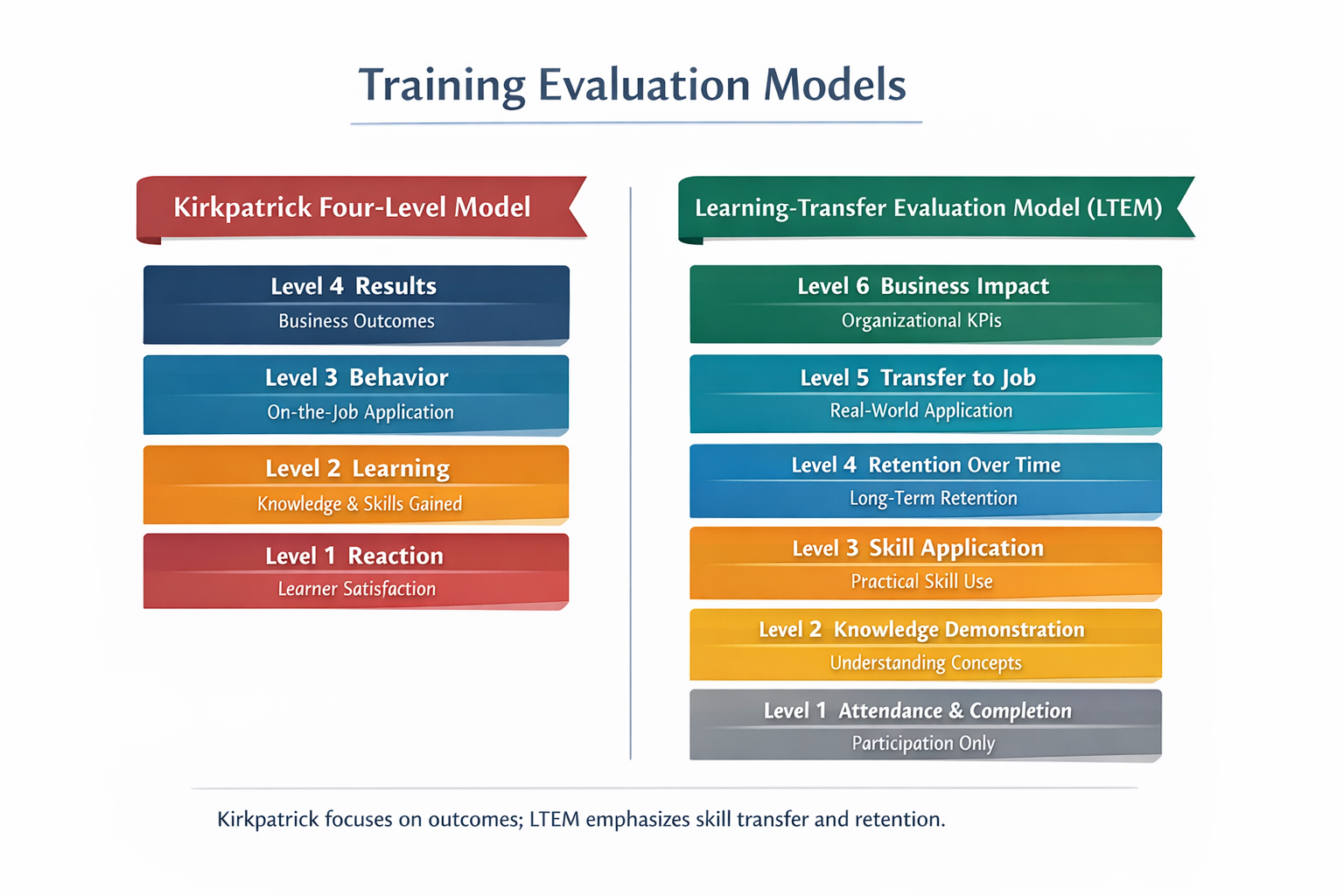
Attendance and satisfaction scores are necessary but insufficient. Industry practitioners increasingly adopt structured evaluation frameworks such as the Kirkpatrick Four‑Level Model and the Learning‑Transfer Evaluation Model (LTEM) to ensure training drives real learning and business results. While Kirkpatrick gives a high-level view of effectiveness, LTEM adds rigour in measuring skill transfer and sustained application, making it ideal for enterprise-grade VILT programs.
Digital environments offer more visibility than physical rooms. The organisations that benefit are those that act on this visibility, not just report it.
Final thought
Organisations that struggle with virtual training often treat it as a faster, cheaper version of classroom learning.
Organizations that succeed treat it as a repeatable capability, a structured performance environment and a scalable mechanism for shared thinking. This shift in mindset from event to system is what separates tactical adoption from strategic value.
Virtual training best practices are not about technology, platforms, or production quality. They are about clarity of intent, discipline of design, and rigour of execution. Organisations that apply these principles consistently will find that virtual training does not dilute learning but sharpens it.
How Corpoladder supports high-impact virtual learning
Corpoladder helps organisations translate learning investments into measurable business impact, combining content expertise, delivery, and structured capability building:
- Custom Learning Solutions: Programs across leadership, AI, digital skills, compliance, ESG, HR, and sector-specific domains align with strategic business objectives for measurable outcomes.
- Flexible Delivery Models: Virtual classrooms, blended formats, or in-person sessions allow global scalability while preserving engagement and practical application.
- Evidence-Based Design: Instructional design principles, scenario-driven exercises, and facilitator-led discussions create learning that is applied, not just consumed.
- Measurable Outcomes: Participation, skill application, and post-program performance metrics give leaders actionable insights into ROI and capability growth.
- Multidisciplinary Expertise: Subject matter experts enable cross-functional learning, addressing emerging skill needs and aligning teams across geographies.
Corpoladder positions virtual learning as a strategic tool for capability building, ensuring programs are rigorous, relevant, and outcome-focused.



.webp)